design-extract Went From 0 to 4,000 GitHub Stars. Here's Every Number, Including the Month It Got Zero.
The real star and download data behind design-extract, my open source design system extractor: 1,000 stars in four days, a slow second month, zero stars in July while GitHub had my account restricted, and the climb back to 4,000.
design-extract is a tool I built because I was tired of copying colours, fonts and spacing out of DevTools by hand every time I wanted to rebuild a look. You point it at a website and it reads the design system off the live page. On npm it's called designlang.
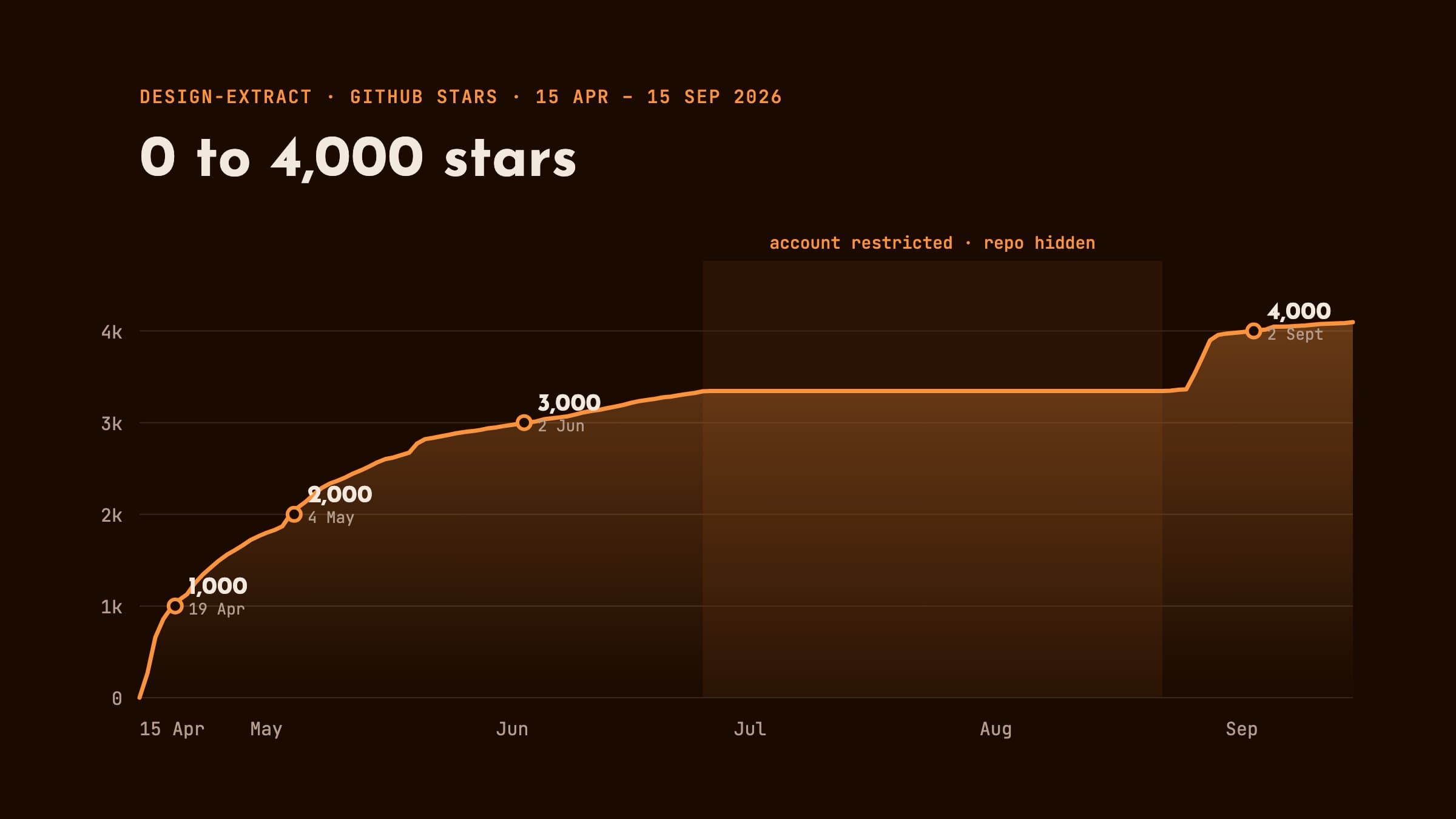
It passed 4,000 GitHub stars on 2 September 2026. Most posts about hitting a star count are a highlight reel, so this one is just the data, including the part where it flatlined for a month.
A note on the numbers: star dates come from GitHub's stargazer API, which records when each current stargazer starred the repo. Download numbers come from npm's public download API. Everything is as of 15 September 2026.
Launch day
The repo went public on 15 April 2026 at 10:11 UTC. The first star came 30 seconds later. I published the npm package three minutes after that.
I shared it on Reddit. Here's how the stars came in:
| Milestone | Date | Days after launch |
|---|---|---|
| 100 stars | 15 April | 0 |
| 500 stars | 16 April | 1 |
| 1,000 stars | 19 April | 4 |
| 2,000 stars | 4 May | 19 |
| 3,000 stars | 2 June | 48 |
| 4,000 stars | 2 September | 140 |
The three biggest days were the first three: 268 stars on launch day, 391 the day after, and 198 on the third. That's 857 stars, about a fifth of everything it has today, in 72 hours.
It also showed up on Trendshift as the #4 JavaScript repository of the day on 15 April and #9 for that week.
Not everything landed. A Hacker News post the next day got 2 points.
Month by month
| Month | New stars | npm downloads |
|---|---|---|
| April (from the 15th) | 1,798 | 6,571 |
| May | 1,178 | 8,771 |
| June | 369 | 5,509 |
| July | 0 | 2,421 |
| August | 643 | 2,267 |
| September (to the 14th) | 113 | 842 |
Two things stand out.
Stars peaked at launch, but downloads peaked in May. The attention came first, and installs kept climbing for another month after the star count had already slowed down.
And then there's July.
The month with zero stars
On 25 June GitHub's automated abuse detection restricted my account. Every public repo I had disappeared, including design-extract, and my profile returned a 404 for anyone who wasn't logged in. I wrote up the whole thing, including the data showing most of the flagged activity came from GitHub's own Copilot, in a separate post.
You can see it in the numbers. June's star count is low because the repo was only visible for 24 days of it. July has zero stars. Nobody can star a repo they can't see.
The npm package didn't care. designlang was downloaded 2,421 times in July while the source was invisible. People who already used it kept using it.
It took 58 days to get the account back. Once it was restored in late August, stars came back quickly: 164 on 25 August, 182 on the 26th and 189 on the 27th, the busiest days since launch week. I can't point to a single cause for that bump, but the repo being findable again was obviously the precondition.
The 4,000th star came on 2 September.
Where it got picked up
Most of the coverage found the project rather than the other way round:
- Two Japanese write-ups, a hands-on review on Qiita and an essay on Zenn about what designlang is useful for
- An article in The Agent Times on launch day
- A listing in awesome-claude that someone else submitted
- A Korean startup evaluating it for catching drift between Figma and a live site
It has also picked up 349 forks, pull requests from outside contributors, and sponsors listed in the README.
What I'd tell someone launching a tool
Only what the data actually shows:
- The first three days are most of your launch. A fifth of all stars came in 72 hours. Have the README, the install command and a demo ready before you post.
- Stars aren't usage. Downloads peaked a month after stars did, and kept going when stars went to zero. If you only watch the star count, you'll misread how a project is doing.
- Your GitHub account is a single point of failure. One automated flag hid the repo for two months. Publishing to npm as well meant people could keep installing it the whole time.
If you want to try it, it's one command: npx designlang https://stripe.com. The code is on GitHub.
Common questions
- How long did design-extract take to reach 1,000 GitHub stars?
- Four days. The repo went public on 15 April 2026 and the 1,000th star landed on 19 April.
- What happens to stars when GitHub restricts your account?
- Your public repos are hidden, so nobody new can find or star them. design-extract picked up 369 stars in June before the restriction on 25 June, then none dated in July, and stars only started again once the account was restored in late August.
- Do npm downloads stop if the GitHub repo is hidden?
- No. The npm package kept working the whole time. designlang still had 2,421 downloads in July while the repo couldn't be seen.